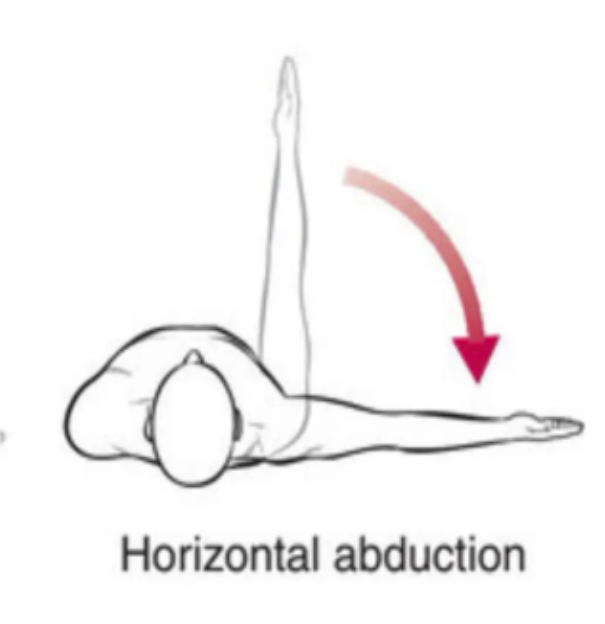
The scapular load or retraction has rapidly become one of the pillars of modern velocity development. Pitchers are taught to pull their elbow far behind the shoulder into horizontal abduction to pinch their scapulae together and create a large stretch in the pectoralis major muscle. But is there validity to this? Is this one of the positions that is contributing to the record number of shoulder injuries that is seemingly climbing every year?
Looking at this position through a purely physics lens, it makes complete sense. If you increase the distance over which the arm can accelerate, it will directly increase the time you have to accelerate the ball. The change in velocity is a function of time and acceleration, so increasing the time that acceleration is applied will directly increase the final velocity of the ball at ball release…assuming that the rate of acceleration stays constant.
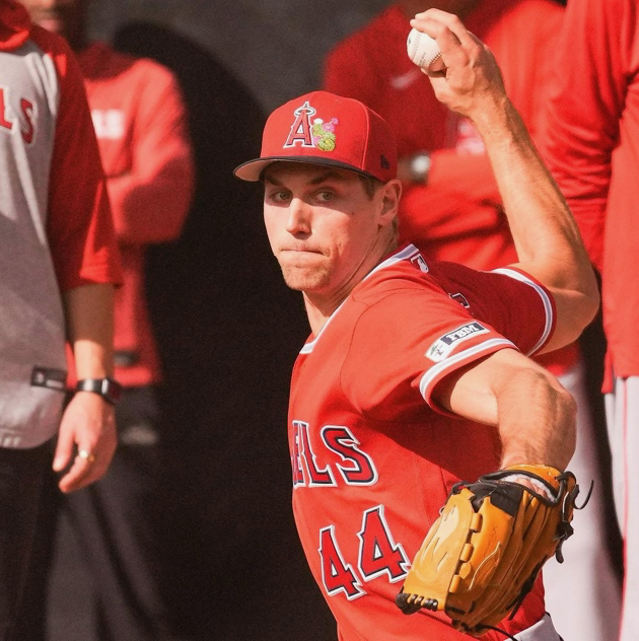
One of the most popular examples of using large amounts of horizontal abduction to generate velocity is Los Angeles Angels pitcher Ben Joyce. Ben Joyce first made headlines in 2022 at the University of Tennessee, where he threw a pitch at 105.5 MPH in a game against Auburn, which still holds up as the hardest pitch in college baseball history. He was then drafted by the Angels in the 3rd round of the 2022 draft and made his MLB debut in May of 2023. The other pitch that he is most known for was a pitch also at 105.5 MPH to strike out Tommy Edman in September of 2024, which is tied for the third hardest pitch in MLB history with Jacob Misirowski and only trails Aroldis Chapman’s 105.7 and 105.8 MPH pitches. But Joyce’s career has been filled with injuries dating back to junior college, when he missed his freshman season due to growth-plate issues. He also missed the 2021 season at Tennessee due to Tommy John surgery to repair his torn UCL. He did not start to have shoulder injuries until 2024, when he missed time due to shoulder inflammation before being shut down again in May of 2025 and subsequently having surgery to repair a tear in his right labrum. He has yet to return to the big-league mound since that surgery, suffering numerous setbacks during his rehab.
Exclusively using physics fails to take into account that throwers are human beings, and there are limitations to human anatomy and certain positions that the body cannot get into without causing additional strain that eventually leads to catastrophic failure at some point. In this position of overhead throwing, as the arm horizontally abducts, there is an anterior glide of the humerus in the glenohumeral joint as a result. This glide creates an anterior shearing force inside the glenohumeral joint, which (particularly if uncontrolled) increases the likelihood of many shoulder injuries, including anterior capsule strain, impingement, rotator cuff strains, and labral tears. This was shown in a 2014 study in the Journal of Shoulder and Elbow Surgery, where 213 pitchers of a wide variety of ages and skill levels were tested using 3D motion capture. The research found a significant positive relationship between the horizontal abduction angle at maximum external rotation and the anterior force at the shoulder (Tagagi et al., 2014). Even though more time is theoretically needed to accelerate the arm to create velocity, excessive levels are not safe for the shoulder, and elite velocity can still be achieved while staying within the desired 0-10 degrees of horizontal abduction at max external rotation.
Looking back at Joyce, there is a strong possibility that his injuries occurred due to the high amount of horizontal abduction in his throw, combined with the high loads that occur at elite-level velocity, which resulted in higher anterior shearing forces in his shoulder than he could handle and recover from. Reducing excessive horizontal abduction at max external rotation to the goal range of 0-10 degrees reduces the shearing force in the shoulder, thereby decreasing injury risk, and, if done properly, will not sacrifice velocity.
Increasing horizontal abduction also focuses on taking advantage of the stretch-shortening cycle in the pectoralis and surrounding musculature by creating a large stretch in these muscles, then concentrically contracting them to increase the acceleration of the arm and ball.
Although this makes sense in principle, studies have shown that professional pitchers, on average, do not use the pec muscle this way. An EMG study in the Journal of Sports Medicine showed that professional pitchers actually use the pectoralis major muscle as a stabilizer in the throw, and they use the latissimus dorsi (lat muscle) as a primary accelerator muscle. This was in vast contrast to the amateurs who use the pec as a primary accelerator and barely recruit their lat. Professionals simply don’t utilize their pec as a primary accelerator and instead utilize massive latissimus loading. This puts the entire concept of increasing horizontal abduction or scap pinch into serious question, as the same increase in horizontal abduction that is being taught will instead decrease lat activation.
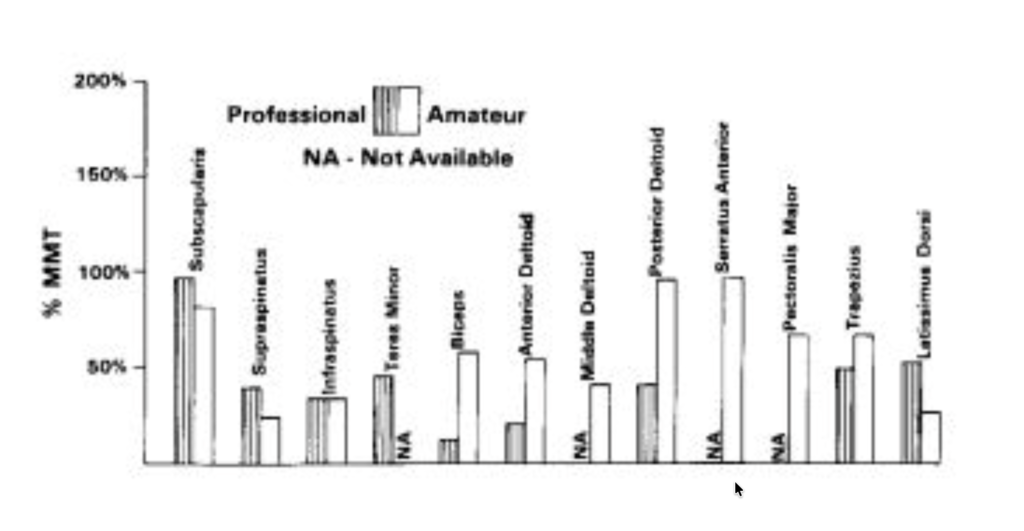
The study also found that professional pitchers use the rotator cuff muscles, such as the subscapularis, supraspinatus, and teres minor, much more than amateurs (Gowan, 1987). The use of these muscles allows for greater stabilization of the glenohumeral joint, which will keep the humerus in the correct position throughout the throw and decrease the risk of injury. In addition, where are muscles in their strongest positions? Muscles are the strongest at the midpoint of length because that’s the length where there is the most overlap of actin and myosin, and the muscle can produce the most amount of force. For example, if you are doing a bicep curl, the strongest position for your biceps to be in mechanically is right about 90 degrees of elbow flexion, where the muscle is not overly stretched or shortened.
Applying this to the throw, the pectoralis major muscle is a large muscle that is capable of producing a lot of force, so wouldn’t you want this muscle in its strongest position? By not horizontally abducting the shoulder more than 10 degrees, the pectoralis major muscle can remain in its strongest position and produce more force to stabilize the glenohumeral joint.
It is easy to see that if the only goal is to create velocity, then using strictly physics will allow you to get there the fastest. But if you want to create sustainable velocity coupled with health, you need to look at the rest of the picture that includes how the human body works optimally and what the body’s limitations are. Ultimately, every coach and athlete has to take into account the constraints of the body in consideration of how body orientation changes muscle activity profiles that may or may not influence injury and velocity.
References:
Gowan, I. D., Jobe, F. W., Tibone, J. E., Perry, J., & Moynes, D. R. (1987). A comparative electromyographic analysis of the shoulder during pitching: professional versus amateur pitchers. The American Journal of Sports Medicine, 15(6): 586–590. doi:10.1177/036354658701500611
Takagi Y, Oi T, Tanaka H, Inui H, Fujioka H, Tanaka J, Yoshiya S, Nobuhara K. Increased horizontal shoulder abduction is associated with an increase in shoulder joint load in baseball pitching. J Shoulder Elbow Surg. 2014 Dec;23(12):1757-1762. doi: 10.1016/j.jse.2014.03.005. Epub 2014 Jun 9. Erratum in: J Shoulder Elbow Surg. 2015 Mar;24(3):502. PMID: 24925702.