What do Shohei Ohtani, Tarik Skubal, Zack Wheeler, and Nolan Mclean all have in common? These 4 elite MLB starting pitchers can be classified as supinators, meaning they naturally release their 4-seam fastball with their hand farther to the outside of the ball than others who create more true backspin. Every pitcher pronates after ball release and through deceleration, but pitchers can be categorized into pronator and supinator buckets based on how pronated they are at ball release. The designations for these buckets are based on 4-seam fastball spin efficiency or active spin percentage, which represents what percentage of the ball’s spin is contributing to pitch movement. The MLB average spin efficiency on 4-seam fastballs is approximately 91%, with the supinator bucket consisting of pitchers 90% and below, and the pronator bucket includes pitchers 95% and above. Pitchers between the two are considered to be in the average range.
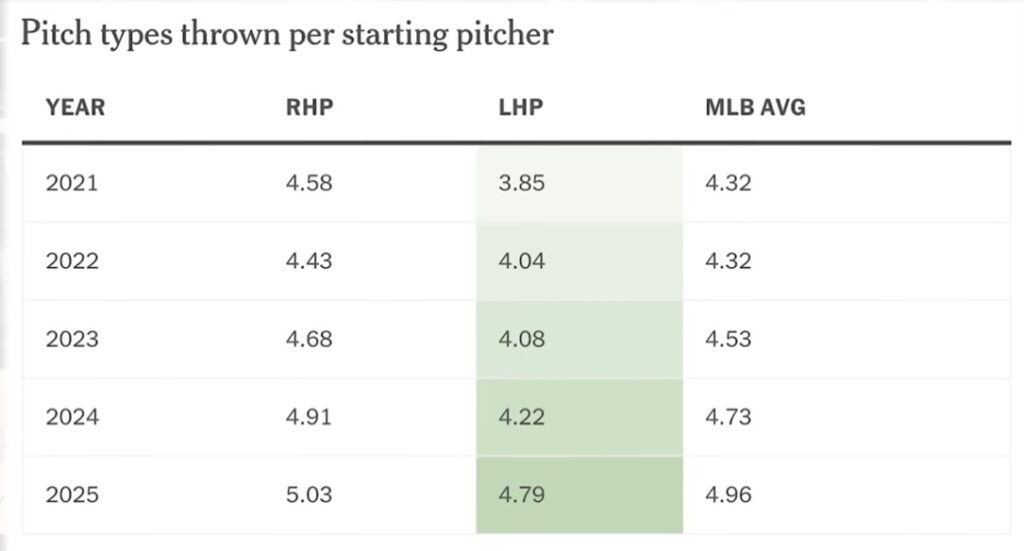
Another similarity between these 4 pitchers is that they all throw 5 or more different pitch types, including 2 or more breaking balls (Slider, Sweeper, Curveball, etc.). MLB teams are pushing not just starting pitchers but relievers as well to expand their mixes beyond just 3-4 pitches because the more pitches a pitcher has, the less chance the hitter has of guessing what’s coming. Expanding a mix from 4 to 6 or 7 pitches reduces the chance of guessing correctly from 1/4 to 1/6, or 1/7. This mix expansion took its first leap in 2023 from 4.32 to 4.53 and has continued to grow at a significant rate, with the average starting pitcher in 2025 having 4.96 pitch types.
But what does mix expansion have to do with pronators and supinators? If you think about throwing a curveball, you think about holding a stiff wrist in a supinated position and finishing straight through the ball, letting the fingers get to the front of the ball at release, creating the front spin and ultimately the 12-6 movement on the pitch. The sweeper is very similar, with the goal of getting the fingers to the outside of the ball, then toward the front to create a 9 o’clock spin direction (for right-handers), resulting in the large glove-side movement or sweep. If a pitcher is a natural supinator, they have an easier time holding supination on their breaking balls, which allows them to create more total movement on these pitches, and they can also throw these shapes harder than their pronator counterparts. On the other side, because pronators naturally struggle to get to the outside of the ball, they struggle to get the same movement out of glove side pitches, often only being able to create a bullet slider shape with 0-5 inches of glove side movement. When pronators are able to create larger breaking ball shapes, they typically are not able to throw them as hard as a supinator can, which can drastically decrease the effectiveness of the pitch. All of this, combined with the pitch-design revolution centered on seam-shifted wake. Seam-shifted wake was discovered in 2019 at the University of Utah and shows that two baseballs with the same spin direction, but different seam orientations, can produce distinct movement shapes. This allows the seam orientation to be changed to create more movement on a pitch in a slightly different direction than the spin. These seam effects can create more movement on every pitch type, but it has been shown to be most useful for sinkers and change-ups, two pitch types that are most effective when they move down and to the arm side of the pitcher. Highly effective sinkers and change-ups have 2-3 o’clock spin directions for right-handers (9-10 o’clock for lefties), which means it was traditionally easier for pronators to create these shapes. Now with the introduction of seam-shifted wake, supinators are able to orient the seams in a way where they are able to feel like they cut the baseball, but due to seam effects, instead of the ball moving like the 1 o’clock (11 o’clock for lefties) spin direction they apply, it moves like a 3 o’clock spin direction, down and to the glove side just as if they were pronating the pitch. The most famous example of this pitch is Tarik Skubal’s change-up, where he actually releases the ball with his fingers on the outside half of the ball, similar to a cutter, but the seam effects take over and create an average of 13.7 inches of glove side movement.
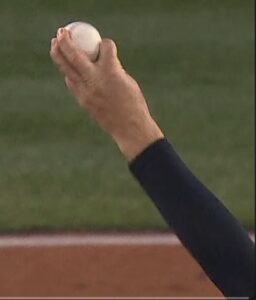
With all of this information in mind, it makes complete sense that MLB teams are targeting supinators to add to their organizations because they can access a greater range of breaking-ball shapes and throw them harder. Along with this, they do not have to sacrifice any glove-side shapes, allowing them to have a repertoire of 6+ elite pitches, whereas most pronators are limited to 4, maybe 5.
MLB teams are even taking this to the next level by trying to teach their pitchers how to cut the ball more and turn them into supinators so they can add more pitches. The team that seems to be at the forefront of this is the Seattle Mariners. Two pitchers that stand out are their closer, Andrés Muñoz, and veteran starter Luis Castillo. Both of them had spin efficiencies in the low 90s in 2025 and have cut them down to 85% and 86%, respectively, in 2026. The biggest transformation in the organization this off-season was former 1st round pick Emerson Hancock, who lowered his spin efficiency from 90% to 82% in 2026 and added more effective sweeper and cutter. This has resulted in a breakout season with a pitching run value currently in the 95th percentile and an ERA approximately 1.5 runs lower than 2025. Something to keep in mind is that trying to change a pitcher from a pronator to a supinator may be difficult, as their joint morphology may not tolerate supination as well as that of natural supinators.
While supination bias may allow for more variety in pitch mix, the elbow is inherently in a less stable position while supinated. A cadaveric study by OAI demonstrates the degree of gapping in the elbow in both pronation and supination under valgus load dramatically changes how and what tissues are loaded. When the elbow is in supination and extended to near 70 degrees, it places the joint in an open-pack (or “loose packed position) position, where much greater medial gapping can occur. In a pronated or closed-pack position, the joint is in a more stable position because there is better bony approximation or congruency, and there is much less slack in the UCL, which limits the amount of play in the joint and therefore limits the amount of gapping that can occur. Additionally, in a pronated position, the flexor pronator muscle group can provide greater stability at the elbow joint and thus reduce strain on the UCL.
Despite evidence showing that increased pronation orientation through acceleration and at ball release is safer for elbow health, MLB teams continue to target supinators and try to cut the spin efficiency of pronators to access more pitch shapes. Although this may seem like a risk worth taking for a billion-dollar organization trying to improve performance, on an individual level, the increased injury risk of holding a supinated open-pack position longer is not worth an extra breaking ball shape or adding 2-5 mph to a curveball or sweeper.
References
Baseball Savant. (n.d.). Baseball Savant. https://baseballsavant.mlb.com/
Lance Brozdowski. (2026, April 10). Elite MLB Teams Optimize THIS. The Rest Don’t Bother. YouTube. https://www.youtube.com/watch?v=nkyizQ-lacA&t=242s